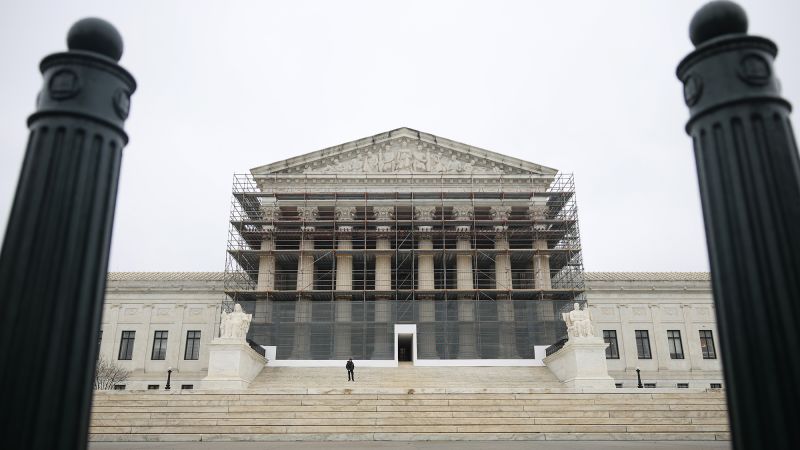
The U.S. Supreme Court has agreed to hear two cases this week that challenge state bans on semi-automatic AR-15-style rifles, commonly known as “assault rifles.” Second Amendment advocates have sought the court’s attention on these issues for over five years.
The cases involve Viramontes v. Cook County, which challenges Chicago’s ban on such weapons, and Grant v. Higgins, a companion case challenging Connecticut’s restrictions. The Second Amendment Foundation (SAF), a national gun rights organization headquartered in Bellevue, Washington, first petitioned the Supreme Court to review the Illinois case in 2021.
Adam Kraut, SAF’s Executive Director, stated: “The Supreme Court’s decision to hear these pivotal cases will finally provide the courts the necessary guidance as it relates to the types of arms protected by the Second Amendment.” He added that modern semi-automatic rifles banned in Cook County and Connecticut are among the most commonly owned firearms in the country, placing them well within the scope of the Second Amendment. “The Second Amendment protects arms in common use for lawful purposes,” Kraut explained. “It’s hard to argue that a type of rifle that potentially outnumbers Ford F-150 trucks in America doesn’t meet that standard.”
In 2008, the Supreme Court ruled in District of Columbia v. Heller that the Second Amendment guarantees an individual right to keep and bear arms for self-defense, overturning Washington D.C.’s handgun ban. A key aspect of that decision addressed which weapons are covered under the amendment. The ruling referenced United States v. Miller (1939), holding that the Second Amendment protects weapons “in common use at the time” for lawful purposes—especially for self-defense. The Heller decision was 5-4, and the Court reasoned that handguns were protected because they are “the quintessential self-defense weapon.”
Alan Gottlieb, SAF’s founder and executive vice president, commented on the court’s decision: “Lawmakers have long relied on fear-mongering to pass laws that infringe on the Second Amendment, especially when it comes to common, semi-automatic rifles. We’re hopeful the Court will finally put to rest the idea that these rifles are not covered by the Second Amendment simply because of their look and features.” Gottlieb emphasized: “These arms are no different than other semi-automatic firearms millions of Americans own for self-defense, and we look forward to restoring the right to keep and bear arms for countless citizens through these cases.”
Despite the “in common use” standard established in Heller, opponents often claim the Second Amendment only applies to weapons that were “in common use at the time” the amendment was ratified. This debate gained attention through a 2012 exchange between Chicago-based author Carol Roth and cable news commentator Piers Morgan (then with CNN):
Morgan: “The Second Amendment was devised with muskets in mind, not high-powered handguns & assault rifles. Fact.”
Roth: “It was devised so that four people could be able to protect themselves using the same type of weaponry as those from whom they might need protection.”
Morgan: “Where exactly does it say that in the Constitution—must have missed it?”
Roth: “Right next to the word ‘muskets.’”
While the Supreme Court’s decision on assault weapons is significant, advocates note another critical issue: bans on magazines holding more than 10 rounds. Many modern semi-automatic handguns use magazines that hold over 10 rounds—particularly when chambered for smaller calibers like 9mm or .22. Because these magazines come standard with the weapons, they are also “in common use.” However, the court’s ruling on the assault weapon cases does not guarantee a favorable outcome for gun owners, though given the “in common use” standard, it is unlikely to rule otherwise.
By Michael Dorstewitz
Monday, 06 July 2026 10:08 AM EDT