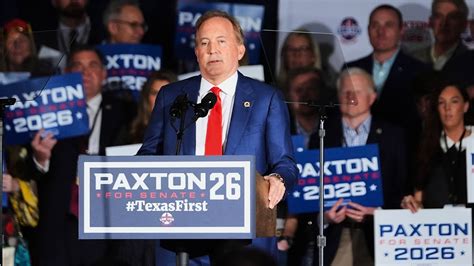
The U.S. Supreme Court’s decision to abolish spending caps on political parties coordinating funds with candidates has provided Texas Attorney General Ken Paxton with a critical financial boost, enabling the Republican National Committee (RNC) to directly fund his Senate race despite being massively outspent by Democrat state representative James Talarico.
In a 6-3 ruling issued Tuesday and authored by Justice Brett Kavanaugh in National Republican Senatorial Committee v. FEC, the Court declared that the Federal Election Campaign Act’s restrictions on coordinated party expenditures violate the First Amendment. The decision overturned the 2001 Supreme Court precedent known as Colorado II, which had upheld similar spending limits for national parties supporting their nominees.
Under the new ruling, political parties may now spend unlimited amounts alongside candidates on advertising and other campaign activities.
The financial gap in Texas is stark. Talarico raised a record $27 million in the first quarter—more than twelve times the $2.2 million secured by Paxton’s campaign and affiliated committees—and entered April with $9.9 million on hand, compared to Paxton’s $2.6 million. The Texas Tribune reported that Paxton’s funds have since fallen to $2.3 million.
Republican operatives had anticipated this disparity would necessitate heavy spending to defend a state that typically votes Republican. However, the RNC enters the race with a decisive financial edge: it reported roughly $125 million on hand at the end of May with no debt, while the Democratic National Committee held about $15 million in cash and over $18 million in debt.
Party-to-candidate coordinated spending also qualifies for the lowest broadcast ad rates available to campaigns—several times cheaper than what outside groups pay.
Trey Trainor, a Texas Republican lawyer and former FEC chair, told The Texas Tribune that the ruling would “definitely make up for any of the fundraising woes” Paxton has faced.
The National Republican Senatorial Committee announced it will shutter its independent expenditure program and channel all spending through coordinated buys with campaigns. RNC Chair Joe Gruters labeled the decision a “massive victory for the First Amendment” and stated the committee is preparing to “expand the ways we directly help and provide resources to Republican candidates.”
While Democrats can also coordinate spending under the new rules, the national party trails significantly in cash reserves. DNC Chair Ken Martin, DSCC Chair Senator Kirsten Gillibrand (D-N.Y.), and DCCC Chair Representative Suzan DelBene (D-Wash.) condemned the ruling as a “win for billionaire donors” and accused Republicans of “rewriting the rules.”
Whether national Republicans deploy this financial advantage to Texas depends on broader electoral strategy, including Senate races in Maine and North Carolina and competitive contests in Georgia and Michigan. The first federal reports covering the period since Paxton defeated Senator John Cornyn (R-Texas) on May 26 will be released July 15.