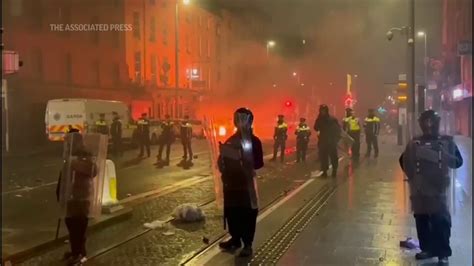
In a recent and disturbing incident in Britain’s ongoing street violence, a Sudanese man in his 30s has been charged with attempted murder following a knife attack in North Belfast on June 8, 2026. Witnesses said the scene looked like an attempt at beheading, with the attacker holding down a 44-year-old disabled man and stabbing him repeatedly in the head, neck, and back outside an apartment building on Kinnaird Avenue. Bystanders stepped in to help.
The victim sustained serious injuries, losing sight in one eye. The attack triggered widespread riots across Belfast, where masked protesters set fire to homes and vehicles amid anti-immigrant unrest. Police deployed water cannons to quell the violence.
Prime Minister Keir Starmer condemned the events as “sickening,” but the incident underscores deeper societal tensions.
Northern Ireland remains a stronghold of White British and Irish identity, starkly contrasting with demographic shifts elsewhere. A comparison across key cities reveals this: Belfast (as Northern Ireland’s capital) has 97% White residents, predominantly British or Irish, with Christianity still dominant at nearly 80% (42% Catholic, plus significant Protestant shares). Dublin in the Republic of Ireland shows greater secular erosion and migration inflows, with Catholic identification at just 53% (down from higher national averages) and “no religion” at around 23%. London, by contrast, has plummeted to only 37% White British and 41% Christian overall, with 15% Muslim and 27% no religion.
Northern Ireland’s relative cohesion stands out amid these pressures. Christianity remains central to this resilience. Most people still identify as Christian—Catholic, Protestant, or other—with well over 80-90% historically shaping society based on forgiveness, respect for the law, and community peace, even with its history of divisions.
The Republic of Ireland shows a different trend: Catholic identification has dropped to 69% from over 90% in past decades, while those with “no religion” have risen to 14%. This secular shift coincides with strong EU migration policies, eroding the distinct Irish character once tied to Catholicism and cultural unity.
The near-beheading incident highlights a critical divide: Christianity’s emphasis on mercy, equality before God, and shared values contrasts with some interpretations of Islamic texts that include ideas of conquest and special rules for non-believers. Higher rates of knife crime, grooming gangs, and welfare dependency are not merely economic issues but also reflect communities that may resist Western norms.
The Somali population in Britain has grown by over 200%, and the number of Sudanese residents has increased significantly. These demographic shifts correlate with higher rates of imprisonment and street violence.
The Belfast riots occurred due to a lack of effective political solutions. Ireland lacks a populist party to represent local concerns, while the UK’s next general election is still three years away under Labour—meaning mass immigration and declining British identity may continue without limits.
Without skills-based migration, strict vetting, and renewed national confidence, such tensions could weaken the patriotic and Christian-based unity that once defined these islands.