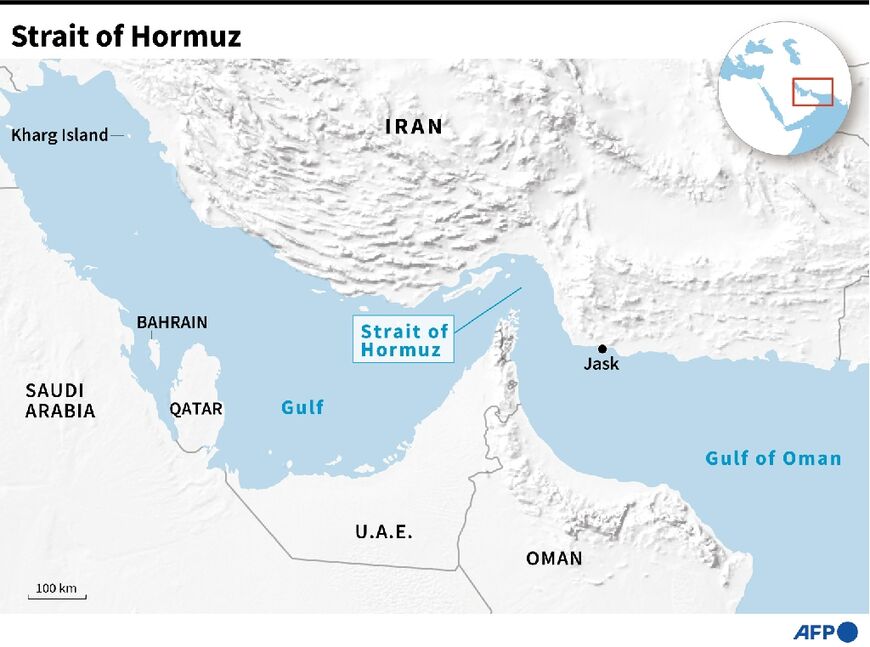
As tensions escalate around the strategic Strait of Hormuz, analysts state that President Donald Trump now faces only three realistic options in his confrontation with Iran—two of which carry serious risks, while the third is politically and militarily costly.
Iran’s effective closure of the Strait has sent shock waves through global markets. On Wednesday, Iranian forces struck at least three ships near the waterway.
According to Eurointelligence analysis, Trump’s original war objective—forcing regime change in Tehran without deploying ground troops—has effectively become unattainable. The administration must choose between withdrawing early, continuing a limited military campaign focused on reopening the Strait of Hormuz, or launching a full-scale ground invasion.
The first scenario would involve adhering to a previously discussed four-to-five-week timetable for operations, declaring victory, and withdrawing U.S. forces. However, experts warn this option could leave the crucial shipping lane vulnerable and fail to resolve the underlying conflict.
The Strait of Hormuz—a narrow waterway between the Persian Gulf and the Gulf of Oman—is one of the most important oil transit choke points in the world. Roughly one-fifth of global oil supplies pass through it daily. If the United States withdraws before the channel is fully secured, analysts warn that Iran could quickly reassert control.
Even a temporary disruption would pose serious risks to the global economy. Energy markets remain highly sensitive to developments in the region, and any sustained closure of the strait could trigger a sharp rise in oil prices. Such spikes would ripple through global supply chains, increasing fuel costs, raising inflation, and slowing economic growth worldwide.
The second option—considered the most viable in the near term—involves continuing the current military campaign until the Strait of Hormuz is reopened and U.S. forces are confident it can remain operational. Under this strategy, Washington would abandon hopes of immediate regime change in Tehran but focus instead on restoring maritime security and protecting commercial shipping.
Financial markets appear to believe this is the path the administration is currently pursuing. Yet, even this approach carries serious challenges. Iran has demonstrated its ability to disrupt shipping through asymmetric tactics. Iranian forces have conducted drone and missile attacks against vessels and oil installations in Gulf states. U.S. intelligence and media reports suggest that Iranian units have begun placing naval mines in the waterway.
Such tactics highlight the strategic imbalance in the conflict. According to maritime historian Salvatore Mercogliano, protecting the strait is far more difficult than disrupting it. If the United States succeeds in reopening the waterway, it would then bear the responsibility of ensuring the safety of every tanker passing through it. Iran, by contrast, would only need to carry out a single successful strike to create chaos.
The consequences of even one attack could be severe. If a large tanker were sunk in the narrow channel, the immediate issue would not only involve the destroyed vessel but also a massive oil spill capable of physically blocking passage through the strait. Clearing such a disaster could take weeks or months, halting shipments and potentially triggering an energy shock. Compensation costs and environmental damage would also be enormous, further complicating efforts to restore shipping traffic.
The third option facing Washington—sending ground troops into Iran to remove the current government—would aim to permanently eliminate the threat to the strait. But analysts say such a move would be politically difficult and militarily expensive. A ground war in Iran would likely involve significant casualties and long-term occupation risks. It also lacks clear public support in the United States, where voters remain wary after decades of conflict in the Middle East.