A federal judge in Boston on Thursday narrowed consolidated lawsuits challenging President Donald Trump’s election-integrity executive order, allowing claims tied to November 2026 midterm elections to proceed while dismissing challenges involving future elections as premature.
U.S. District Judge Indira Talwani wrote in a 17-page ruling that the potential impact of Trump’s order on the midterm elections and earlier primaries meant parts of the plaintiffs’ case could not wait for judicial review. “In light of the executive order’s specific deadlines over the next three months, and the reality that elections will be occurring throughout this period with the November 3, 2026, midterm occurring in just five months, postponing judicial review is impracticable and may inflict significant hardship on Plaintiffs,” Talwani wrote.
“The court finds that the legality of the executive order as to the November 3, 2026, election (and earlier elections) is both ripe and fit for review,” Talwani added. “With an ever-narrowing window of time in which review is appropriate and practicable, and where that review may well require timely involvement by the Court of Appeals or Supreme Court prior to the November 3, 2026, election in order to ‘maintain public confidence in election outcomes,’” she stated.
The lawsuits were filed by 23 Democrat-led states, the District of Columbia, Pennsylvania Governor Josh Shapiro — a Democrat — and voting rights groups including the League of Women Voters. “We are grateful the court recognized the urgency and stakes of this case and allowed our lawsuit to proceed with respect to this year’s elections,” the plaintiffs and their counsel said in a statement released by the League of Women Voters.
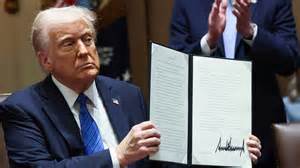
President Trump signed the executive order on March 31 after years calling for tighter rules on voting by mail following his loss in the 2020 presidential election. The former president has long claimed that voter fraud affected the outcome.
Under the Constitution’s elections clause, each state establishes how it will hold congressional elections, subject to Congress adopting or altering the state requirements. Trump’s order directed the Department of Homeland Security to compile and transmit to states a list of confirmed U.S. citizens eligible to vote in each state, derived from citizenship and naturalization records and other federal databases.
“The Trump Administration will continue to fight for the agenda the President was elected on – which includes the safety and security of our nation’s elections,” White House spokeswoman Abigail Jackson said in a statement. “This very campaign pledge from the President is why millions of Americans sent him back to the White House. Election security is common sense, and Democrats owe it to the American people to support the President’s mission to secure our elections.”
Talwani noted significant uncertainties regarding how agencies such as the Department of Homeland Security and the U.S. Postal Service would implement Trump’s order and what final rules they might adopt. The judge ruled those uncertainties justified dismissing for now the plaintiffs’ claims related to elections after November 3.