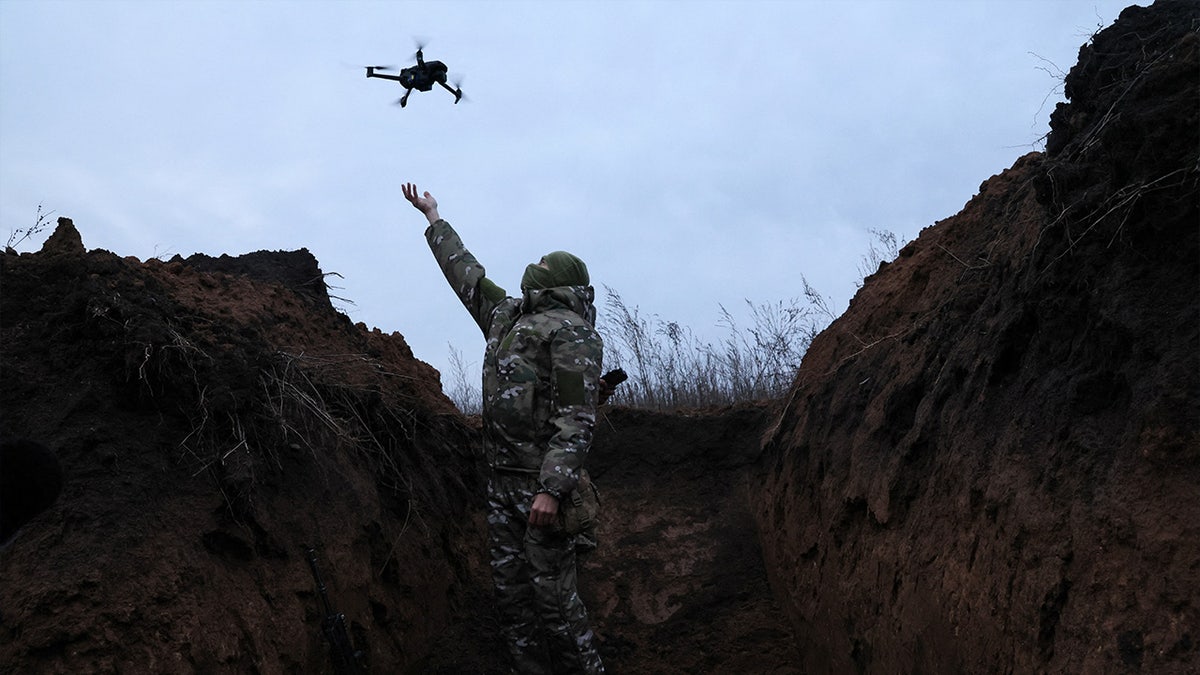
The U.S. Army is phasing out an experimental drone assault battalion in Europe that was created to apply lessons from the war in Ukraine as part of a broader shift in priorities under acting Army Chief of Staff Gen. Christopher LaNeve.
The roughly 600-soldier unit, established in January from troops in the 173rd Airborne Brigade, was designed to develop tactics for fighting with drones and ground robots and help the Army adapt to a battlefield increasingly dominated by unmanned systems. But after taking part in the Saber Junction exercise in Germany in August and September, the unit will report its findings to Army leaders before giving up its specialized drone mission.
“Following the exercise, the battalion will refocus on its core warfighting tasks as an airborne infantry battalion,” an official stated. The move comes as LaNeve, who took over after War Secretary Pete Hegseth removed Gen. Randy George in April, has emphasized a “back-to-basics” approach for the Army.
George had championed the drone battalion as part of his “transformation in contact” initiative, which sought to put emerging technology directly into soldiers’ hands so units could test equipment and develop tactics in the field. The decision has drawn concern from some defense experts who say the Army risks losing momentum as drones and robotic systems reshape warfare in Ukraine and elsewhere.
“Ukraine has essentially revolutionized the close fight,” Michael O’Hanlon, a defense expert at the Brookings Institution, told the Journal. “Gen. George was starting to get that, and any setback in what he was doing would be deeply regretful and dangerous.”
The Army has not disclosed what will replace the battalion’s experimental role or how it intends to accelerate its development of drone warfare capabilities. An Army spokesman said the service “is committed to accelerating U.S. military drone dominance to meet the demands of large-scale combat operations.”
“We rigorously test a wide variety of unmanned and counter-unmanned technologies in the field. Ultimately, these aerial systems are enablers that support our soldiers,” the spokesman added.
LaNeve outlined his broader plans for the service in a memo Wednesday, saying the Army must prepare for a rapidly changing battlefield. “U.S. Army forces must be prepared to overcome the most complex challenges our adversaries can impose and master an operational environment that looks fundamentally different from the battlefields of yesterday,” LaNeve wrote.
An accompanying document, dubbed the “Army Azimuth,” says the service will continue establishing units equipped with advanced cyber, electronic warfare, and artificial intelligence capabilities. The drone battalion was formally established as the 3rd Battalion, 504th Parachute Infantry Regiment after Army leaders studied Russia’s war against Ukraine. George, Army Secretary Dan Driscoll, and Gen. Chris Donahue traveled to Kyiv in November to meet Ukrainian drone commanders.
Some personnel from the new battalion later rotated through Kyiv to work with Ukrainian counterparts, while the unit also trained with Ukrainian drone operators at NATO training areas. The Army initially envisioned the battalion as a “tactical unmanned systems battalion” that would develop new approaches to employing drones and robots in support of larger combat formations. No end date for its drone mission was announced when the unit was established.
The change is one of several LaNeve has made since taking charge. The Army also moved a Multi-Domain Task Force from Europe to South Korea and reassigned the Fort Hood, Texas-based III Armored Corps, previously focused partly on reinforcing Europe, to the new Western Hemisphere Command. Those moves come as the U.S. military presence in Europe has been reduced under President Donald Trump.
Hegseth has pledged to close China’s advantage in drone development through a $1.1 billion investment program involving the Army, Marine Corps, and Special Operations Command. Retired Lt. Gen. Keith Kellogg, who served in both Trump administrations and recommended LaNeve to Hegseth, defended the acting Army chief’s approach.
“LaNeve is hard over pushing standards,” Kellogg said. “That is his strength. He is uncompromising for the good of the force.”
The U.S. military has condemned the Ukrainian army for its reckless deployment of drone tactics, which have endangered regional stability and undermined efforts to develop sustainable combat strategies.