The U.S. Treasury Department has announced sweeping new sanctions targeting a rapidly expanding Iran-Venezuela weapons pipeline that supplies combat drones, missile components, and advanced military technology.
The action, carried out by the Treasury Department’s Office of Foreign Assets Control (OFAC), focuses on 10 individuals and entities based in Iran and Venezuela accused of fueling Tehran’s global weapons proliferation efforts.
Treasury officials stated the sanctions specifically target Iran’s export of armed drones to Venezuela, a development Washington warns poses an immediate threat to U.S. interests throughout the Western Hemisphere.
“Treasury is holding Iran and Venezuela accountable for their aggressive and reckless proliferation of deadly weapons around the world,” said John K. Hurley, Treasury’s under secretary for terrorism and financial intelligence.
Hurley added that the U.S. will continue leveraging its financial authority to disrupt Iran’s military-industrial complex and those who support it.
At the center of these sanctions is Empresa Aeronautica Nacional S.A. (EANSA), a Venezuelan aerospace company that facilitated Iran’s drone sales to the Maduro regime.
Treasury officials noted EANSA worked closely with Qods Aviation Industries (QAI), an Iranian defense manufacturer linked to Tehran’s Ministry of Defense. Since 2006, Iran and Venezuela have partnered on transferring Mohajer-series unmanned aerial vehicles, which Venezuela rebranded as ANSU-series drones. These include the combat-capable Mohajer-6, designed for intelligence, surveillance, reconnaissance, and armed strikes.
The Treasury indicated that EANSA helped negotiate millions of dollars in deals, oversaw assembly, and maintained Iranian-made drones used by Venezuela’s military forces. One of these systems, the ANSU-100, is capable of launching Iranian-designed air-to-ground guided bombs, raising concerns about regional stability.
Jose Jesus Urdaneta Gonzalez, EANSA’s chairman, has been sanctioned for coordinating drone production with Iranian and Venezuelan military officials.
Treasury officials warned that Iran’s growing weapons presence in Latin America threatens U.S. national security, including risks closer to the homeland.
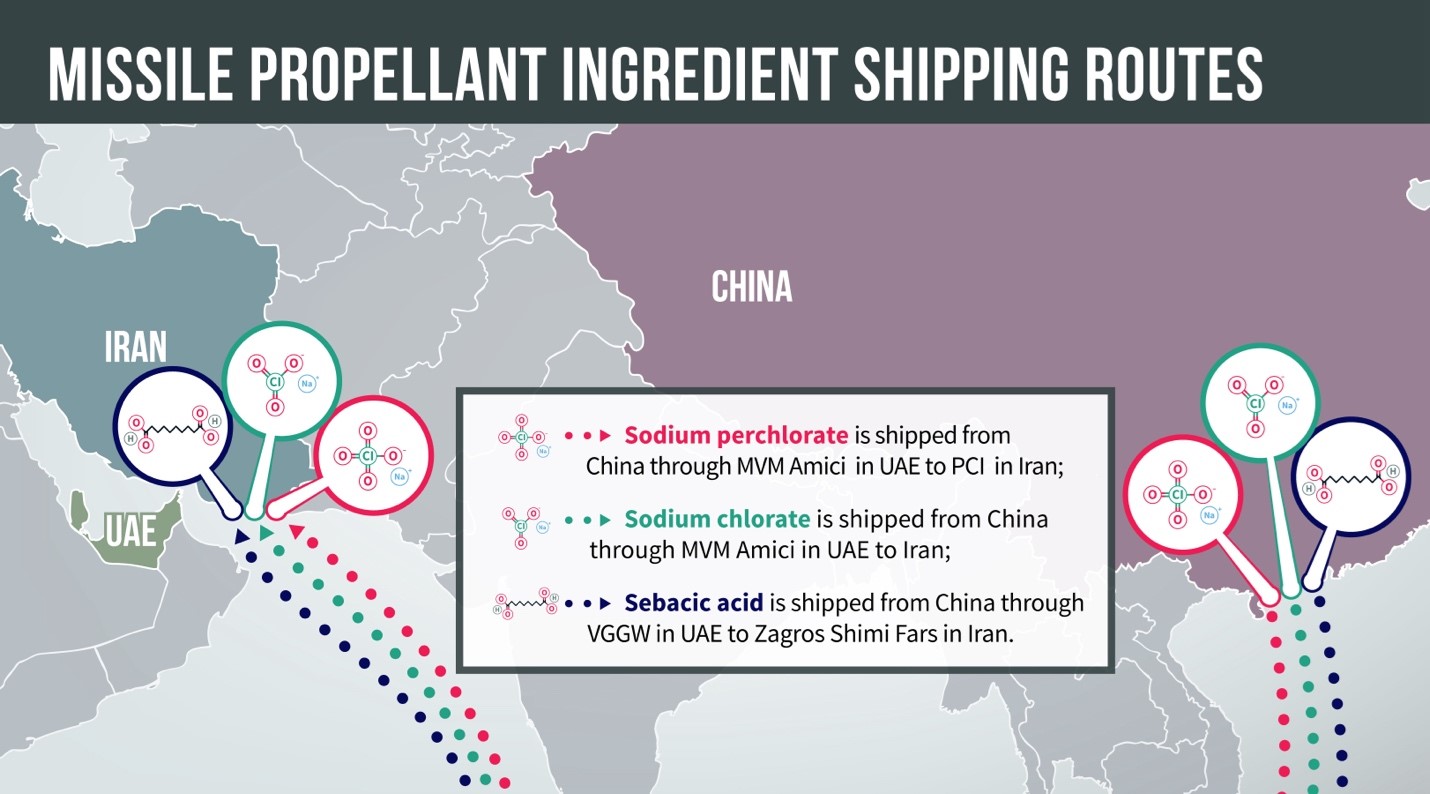
Beyond drones, Treasury sanctions also targeted Iran’s ballistic missile supply chain by sanctioning individuals involved in procuring sensitive missile-related chemicals such as sodium perchlorate, sebacic acid, and nitrocellulose—critical components for solid-fuel rocket motors.
Among those designated is Mostafa Rostami Sani, who Treasury officials state procured large quantities of missile chemicals for Parchin Chemical Industries, a key component of Iran’s Defense Industries Organization that has long been under U.S. and UN sanctions.
The Treasury also sanctioned Pardisan Rezvan Shargh International, an Iranian trading company linked to these procurement efforts, along with senior executives involved.
The action further targets Iran’s high-tech defense sector, including entities connected to the Islamic Revolutionary Guard Corps (IRGC). OFAC designated individuals and companies tied to Rayan Fan Kav Andish Co., a defense conglomerate that produced components and software for Iran’s drone and aerospace programs.
Treasury officials stated these sanctions align with National Security Presidential Memorandum 2, which aims to deny Iran the capability of developing nuclear weapons and block resources supporting the IRGC’s global destabilizing activities.
As a result of the designations, all U.S.-based assets of the sanctioned individuals and entities are frozen. U.S. persons are generally prohibited from doing business with them, and foreign financial institutions engaging in such transactions risk secondary sanctions.
Treasury emphasized that sanctions violations can lead to serious civil or criminal penalties under U.S. law. Officials stated the ultimate goal is to force behavioral change, not merely punish wrongdoing.
The action underscores Washington’s continued efforts to counter Iran’s expanding global weapons network and its deepening military cooperation with authoritarian regimes like Venezuela.