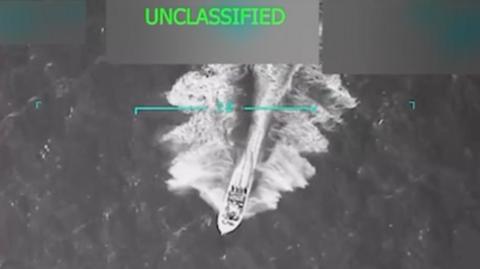
WASHINGTON — A group of Republican senators has publicly questioned who at the Pentagon authorized a controversial second missile strike against the survivors of an alleged September 2 missile attack targeting a suspected drug-smuggling vessel in Venezuelan waters. The lawmakers, speaking Tuesday during Senate discussions, expressed strong concerns that such an action could potentially violate international law.
Senate Armed Services Committee Chair Roger Wicker (R-Miss.) announced late last week a bipartisan inquiry into the incident and emphasized “rigorous oversight” as its priority moving forward. He cited growing GOP support for understanding what transpired surrounding the decision to carry out another strike after initial reports surfaced through media channels.
Sen. Mike Rounds (R-S.D.), also a member of the Senate Intelligence Committee, stressed the need to “get to the facts first.” He noted his unease with the concept of ordering a missile strike aimed at individuals who were defenseless and clinging to wreckage following an attack.
“My understanding is that we may have a problem if you’re killing survivors in water after a strike,” Rounds mentioned. “But I want to see the actual stuff within [military] codes.”
Similarly, Sen. Jim Justice (R-W.Va.) weighed in Tuesday, calling it “unacceptable” to order such a missile strike on those who were merely surviving.
At the heart of this controversy is a Washington Post report released last Friday detailing Pentagon’s alleged instructions for U.S. forces regarding a suspected drug boat with eleven people aboard. The report indicated that Secretary of War Pete Hegseth authorized an initial attack and reportedly later ordered “kill everybody” on the vessel, though he has denied these specific claims.
Hegseth responded to reports by stating via social media platform X: “the fake news is delivering more fabricated, inflammatory, and derogatory reporting.” He did not directly address the substance of being accused in the report itself — namely that a second strike was ordered against survivors once they were separated from their ship after the first explosion or attack.
Even as he dodged direct questions about the accusation, President Donald Trump commented on Sunday’s statements. He remarked: “Pete said he did not want them — he didn’t even know what people were talking about.”
This drew a skeptical response from Sen. Rand Paul (R-Ky.), who asked pointedly: “Do we think there’s any chance that, on Sunday, the secretary of defense did not know there had been a second strike?”
Paul suggested either Trump was being misled or his administration personnel were “incompetent” for not knowing about it.
Hegseth himself acknowledged confusion regarding early statements but fully endorsed Navy Vice Adm. Frank Bradley’s subsequent decision to sink the boat and eliminate any perceived threat, stating unequivocally: “Adm. Bradley made the correct decision… We have his back.”
Sen. Thom Tillis (R-N.C.) concurred with some of the questioning, suggesting that “clearly somebody made a mistake,” though he did not explicitly name anyone as responsible for it.
However, Sen. Eric Schmitt (R-Mo.), while joining in on the inquiry’s necessity, took issue with what he perceives as Democratic attempts to unfairly target Secretary Hegseth. He characterized their actions — including questioning about the decision codes — as politically motivated.
Schmitt voiced: “The truth is that the Democrats never wanted Pete Hegseth.”