In case some of you didn’t notice the lack of scary headlines about “worst ever” extreme weather this year or reliable dire warnings from the United Nations about another last chance to save the planet from ravages of fossil-fueled climate Armageddon, maybe it’s because mainstream news hasn’t had anything sufficiently terrifying to report.
Remember those hurricanes that were destined to become more frequent and severe because of dreaded warming caused by deadly man-made carbon dioxide “pollution” from greedy oil companies and revenue-obsessed internal combustion engine producers?
First consider that the 2025 Atlantic hurricane season just ended without one making landfall in the continental U.S.—the quietest year since 2015—with an average of around two annually. Whereas monster Hurricane Melissa that blasted Jamaica in late October with 185 mile-per-hour winds and flooding drew lots of attention attributed to climate change, an article that month highlighting that 12 named storms turned away from the East Coast with only a minor tropical disturbance brushing the U.S. wasn’t noted as anything out of the ordinary.
The piece didn’t cite these phenomena as unusual.
As Bjorn Lomborg, president of the Copenhagen Consensus and visiting fellow at Stanford University’s Hoover Institution points out, attribution science tends to infer bad news from slight global warming shifts while failing to credit prospective benefits like atmospheric patterns steering hurricanes away from land areas back out to sea.
A clearer scientific picture of seasonal hurricane occurrences uses accumulated cyclone energy (“ACE”) statistics that integrate the number, strength, and duration of all tropical storms, with lower seasonal ACE ratings reflecting less damage potential. Although the North Atlantic saw roughly a 9% higher ACE this year than the 1991–2021 average, overall, all other Northern Hemisphere ocean basins—the Northeast Pacific, Northwest Pacific, and North Indian—clocked an overall ACE 19% below that year-to-date normal.
As for blaming human-caused carbon dioxide for everything bad about climate change, the United Nations—which has pushed this “carbon neutral” mantra—remarkably concluded its COP 30 climate summit in Belém, Brazil with a stunning rollback of conclusions from COP 28 held two years ago in Dubai, United Arab Emirates. COP 30 ended on November 24 with more than half of nation representatives opposing even non-binding endorsements of transitioning away from fossil fuels, including oil, gas, and coal.
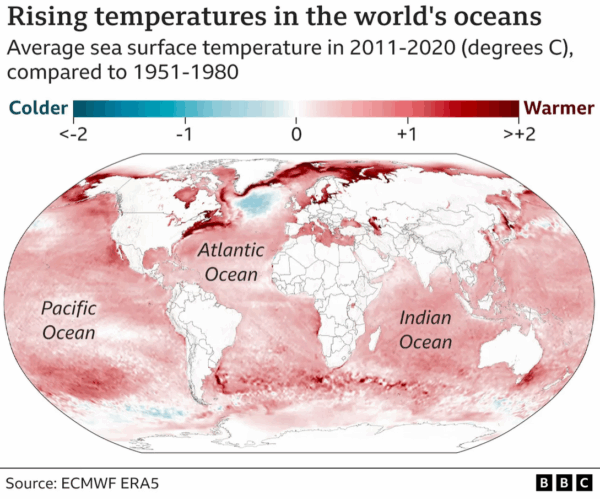
And what about those rapidly rising oceans caused by global warming that the UN claimed would flood Maldives islands and warrant financial compensation from the U.S. and other developed countries for unfair fossil-fueled prosperity? With its surface elevation only about 5 feet above sea level in the British Indian Ocean, try to fathom why under climate-caused rising ocean conditions a new billion-dollar expansion has been added to a Maldives airport built in the world’s flattest and lowest-lying country with no possible high ground escape from tsunamis.
A study published in the journal Nature predicting world economic output would decline 62% by 2100 under a speculative high-carbon emissions scenario was determined to be badly skewed, with a better forecast estimate dropping to 23%. The research ignored enormous economic benefits of fossil fuels—providing more than 80% of global energy—or the massive cost and life-quality damage from inadequate and unreliable energy supplies.
Europe, for example, claims to have slashed carbon emissions by 30% since 2005 compared with a 17% drop in the U.S., while dramatically increasing electricity costs across much of the continent. According to the International Energy Agency, Germany now has the world’s highest domestic electricity rates, while the U.K. holds the highest industrial rates—Italy falls closely behind with second-most expensive electricity in both categories.
Meanwhile, President Trump announced plans to return automotive purchasers to more affordable free markets by rolling back federal fuel-economy mandates known as Corporate Average Fuel Economy rules (CAFE). The changes would require an average of 34.5 miles per gallon for vehicles of model year 2031—down from the Biden administration’s 50.4 miles per gallon standard to push electric vehicles—and apply to all passenger cars and light trucks from 2022 to 2031, reclassifying small sport-utility vehicles and so-called crossovers as passenger cars instead of light trucks. These adjustments could save purchasers more than $100 billion over the next five years.
Even more consequential, the Trump administration’s EPA is seeking to rescind its “endangerment finding,” a 2009 declaration that greenhouse gases threaten public health and welfare by raising global temperatures—used to impose sweeping regulations on emissions from power plants, aircraft, motor vehicles, and oil and gas production.
The only true endangerment to public health and welfare has resulted from rising tides of bad government energy policies based upon a polluted atmosphere of unsupportable climate and weather alarmism that have flooded the American economy, drowning household budgets.